Shade can be a gift in a Central Texas garden, but it creates a very particular growing environment. Under live oaks and other mature trees, plants often face two stresses at once: limited sunlight and intense competition for water. Add shallow limestone soil, summer heat, and occasional freezes, and many plants labeled simply “shade tolerant” will struggle.
The best choices are plants that match the type of shade you actually have. The list below emphasizes native and well-adapted plants that handle Austin-area conditions, with honest notes about water, spread, and maintenance.
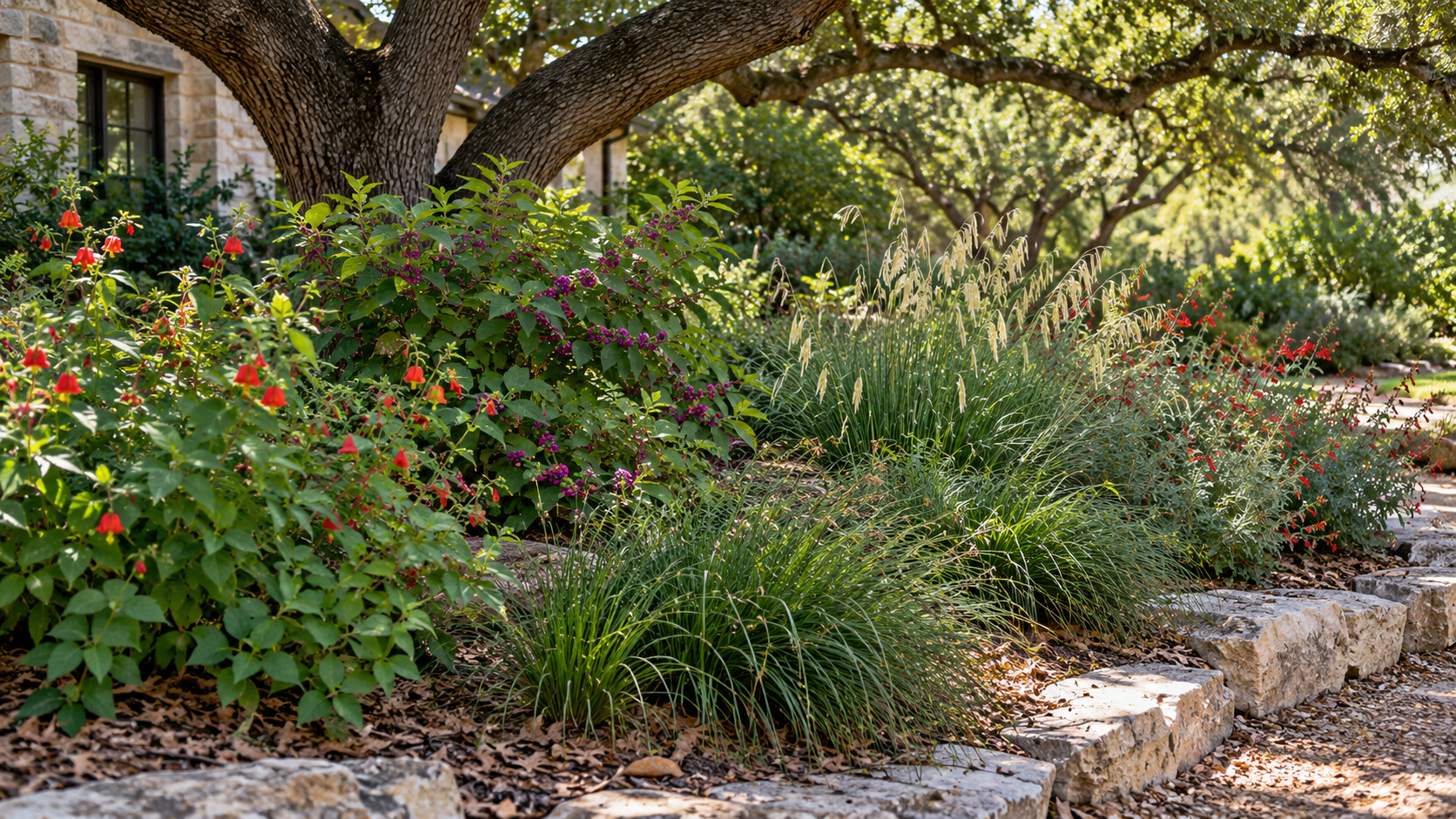
First, identify your kind of shade
Before buying plants, watch the bed at several times of day. “Shade” may mean:
- Bright or filtered shade: high tree canopy or shifting, dappled light.
- Morning sun and afternoon shade: one of the easiest exposures for flowering plants in Central Texas.
- Dry shade: little direct light plus root competition beneath established trees.
- Moist shade: protected soil that stays evenly moist because of drainage, irrigation, or deeper organic soil.
A plant that thrives in moist woodland shade may fail under a live oak even if both locations receive the same number of hours of sun. Soil moisture is just as important as light.
Quick comparison: 12 shade plants for Central Texas
| Plant | Best light | Water after establishment | Typical size |
|---|---|---|---|
| Turk’s cap | Part shade to shade | Low to moderate | 3–6 ft. |
| American beautyberry | Part shade | Low to moderate | 4–6 ft. |
| Yaupon holly | Sun to shade | Low | Varies by cultivar |
| Inland sea oats | Part shade to shade | Low to moderate | 2–4 ft. |
| Cedar sage | Part shade to shade | Low | 1–2 ft. |
| Texas sedge | Part shade to shade | Low to moderate | 8–12 in. |
| Horseherb | Part shade to shade | Low | 3–8 in. |
| Texas Gold columbine | Part shade | Moderate | 1–2 ft. |
| River fern | Part shade to shade | Moderate | 2–3 ft. |
| Dwarf palmetto | Part shade to shade | Low to moderate | 3–6 ft. |
| Coralberry | Part shade to shade | Low | 2–4 ft. |
| Cast iron plant | Shade to deep shade | Low | 1–2 ft. |
Sizes vary with soil, water, cultivar, and pruning. “Low water” does not mean no water during establishment.
1. Turk’s cap
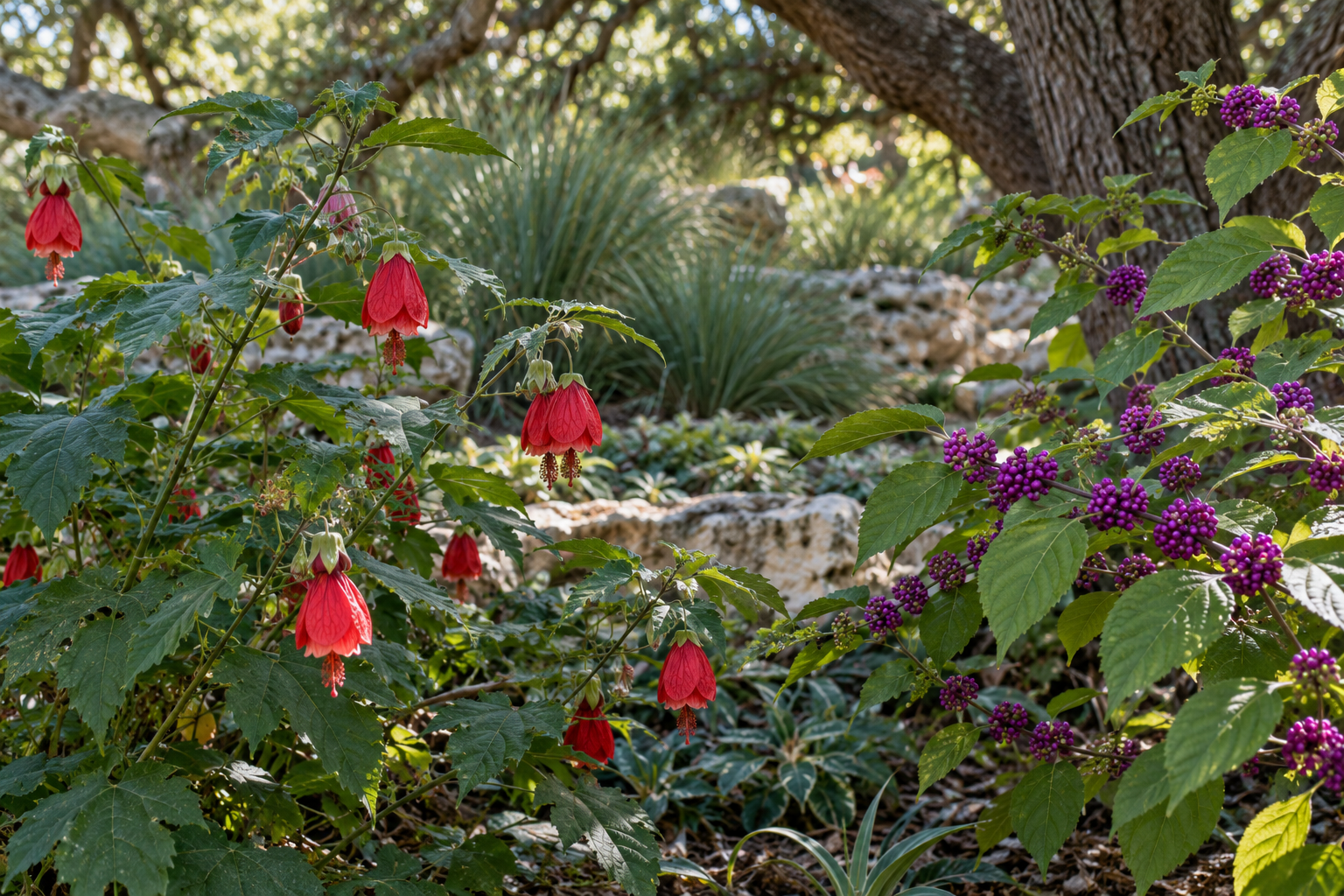
Malvaviscus arboreus var. drummondii is one of the most dependable flowering plants for hot Texas shade. Its curled red flowers appear through the warm season and attract hummingbirds. The plant can form a broad colony, making it useful behind shorter perennials or along a shaded fence.
Turk’s cap flowers best with some filtered light or morning sun, but it remains useful in heavier shade. It may die back after a freeze and return from the roots. Allow room for its informal shape, or cut it back in late winter.
2. American beautyberry
Callicarpa americana is a loose, arching native shrub best known for clusters of vivid purple berries in late summer and fall. It works well at a woodland edge or in the middle layer beneath taller trees. Birds use the fruit, while the foliage gives a lush look during the growing season.
Beautyberry tolerates dry periods once established, but looks fuller with occasional deep watering. It is deciduous and can be pruned hard in late winter if a more compact plant is preferred.
3. Yaupon holly
Ilex vomitoria is an exceptionally adaptable evergreen native. Depending on the cultivar, it can serve as a low mounding shrub, hedge, screen, or small multi-trunk tree. It accepts shade, heat, alkaline soil, and drought better than many conventional foundation shrubs.
Only female plants produce the familiar red berries, and fruit set normally requires a nearby male plant. Dense shade also reduces berry production. Choose a named cultivar based on mature size instead of planning to keep a large form small through constant shearing.
4. Inland sea oats
Chasmanthium latifolium is a native ornamental grass for shade. Flat, dangling seed heads add movement and turn from green to bronze. The foliage is effective in drifts, on slopes, and in naturalistic beds.
This is a vigorous plant in favorable conditions. It spreads by rhizomes and seed, especially where the soil receives regular moisture. Use it where a colony is welcome, remove seed heads before they mature, or avoid it in a small formal bed.
5. Cedar sage
Salvia roemeriana is one of the most useful small perennials for dry, rocky shade. It naturally occurs around limestone and under junipers and oaks. Scarlet spring flowers rise above low foliage and provide nectar for hummingbirds.
Cedar sage needs sharp drainage and dislikes being kept wet. It often goes partly dormant in summer, so combine it with plants that carry the bed through the hottest months rather than expecting a lush year-round mound.
6. Texas sedge
Carex texensis forms fine-textured clumps that can replace the visual role of grass in areas too shady for a conventional lawn. It is effective between stepping stones, along bed edges, and as a soft matrix beneath shrubs.
Texas sedge is not a turf substitute for heavy traffic. Plant plugs in groups and mulch between them while they establish. Occasional trimming in late winter refreshes the foliage.
7. Horseherb
Calyptocarpus vialis is the small groundcover with tiny yellow flowers that often appears naturally in shaded Central Texas yards. It survives mowing, fills gaps, and supports small pollinators. For gardeners willing to accept a relaxed, meadow-like lawn, it can be more realistic than fighting to grow dense turf under trees.
Horseherb can spread where it is not wanted and may thin or disappear during drought, then return after rain. Use edging and selective hand removal rather than expecting it to behave like a formal evergreen carpet.
8. Texas Gold columbine
Texas Gold columbine is prized for long-spurred yellow flowers in spring. It prefers bright shade, morning sun, and soil that stays cooler and more evenly moist than a typical exposed Austin bed.
This is not the first choice for the driest zone beneath a large live oak. Place it near a shaded patio, drainage swale, or irrigated bed with good organic matter. In the right microclimate it may reseed gently.
9. River fern
Thelypteris kunthii, also called southern shield fern, adds a soft woodland texture and tolerates Texas heat better than many ornamental ferns. It spreads to make a colony in protected, moist shade.
River fern is best where it can receive occasional water. It may look tired or go dormant in drought and can be damaged by freezes, but established plants usually return. It is especially useful beside rain gardens, downspouts, or low areas that drain well but retain moisture.
10. Dwarf palmetto
Sabal minor is a native palm with bold fan-shaped leaves. It grows slowly and gives deep shade a strong architectural accent without requiring tropical levels of maintenance.
Although established plants are resilient, dwarf palmetto performs best in deeper soil with some moisture. Mature width matters: place it where the rigid leaves will not crowd a narrow walkway.
11. Coralberry
Symphoricarpos orbiculatus is a native deciduous shrub that accepts shade, limestone soil, and root competition. Small pinkish berries persist into the cool season and the arching stems create useful cover for wildlife.
Coralberry spreads by suckers. That makes it valuable for erosion control and informal woodland beds, but less suitable beside a crisp border. Mow or dig the outer shoots if the colony moves beyond its assigned space.
12. Cast iron plant
Aspidistra elatior is not native to Texas, but it earns a place on the list because it handles very deep shade where flowering natives may not thrive. Its evergreen leaves create a clean, durable ground layer near foundations, courtyards, and covered entries.
Give it drainage and protection from harsh afternoon sun, which can bleach or scorch the leaves. Old or freeze-damaged foliage can be removed near the ground in late winter. Use it selectively rather than allowing one evergreen species to replace a diverse planting.
How to plant successfully under mature trees
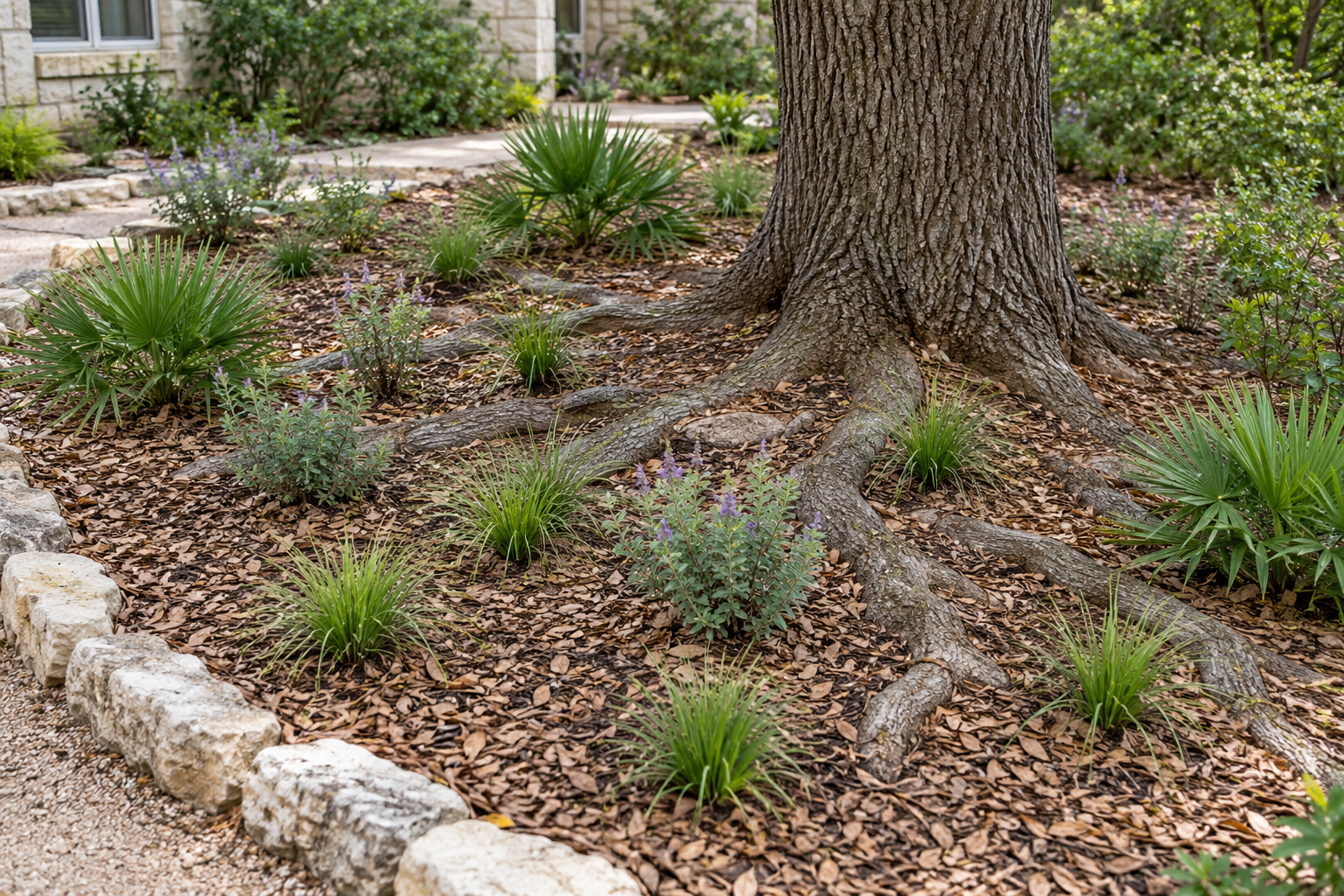
- Do not raise the soil level around the trunk. Burying existing roots can harm a mature tree.
- Start with small plants. A narrow planting hole disturbs fewer tree roots than a hole for a large container.
- Use 2–3 inches of mulch. Keep mulch several inches away from trunks and plant crowns.
- Water the root ball, not just the surrounding soil. New plants need consistent moisture through their first hot season, even when labeled drought tolerant.
- Expect slower growth. Shade and root competition naturally limit growth; extra fertilizer will not fix the wrong site.
- Leave leaf litter where practical. It moderates soil temperature, returns organic matter, and supports the woodland food web.
A simple plant combination for dry shade
For a low-maintenance bed beneath high-canopied trees, use yaupon holly or American beautyberry as the shrub layer, repeat groups of Turk’s cap and cedar sage for flowers, then knit the open ground together with Texas sedge or horseherb. Add inland sea oats only where its spread will be easy to manage.
In a moister protected corner, substitute river fern and Texas Gold columbine. Repeating a few well-matched species usually looks more intentional—and survives better—than planting one of everything.
Local resources
The City of Austin’s Grow Green Plant Guide helps gardeners filter native and adapted plants for Austin-area conditions. The Lady Bird Johnson Wildflower Center also maintains a focused collection of plants for dry shade in Central Texas. Use these local references to verify mature size, soil preference, and availability before finalizing a planting plan.