The ground beneath a mature live oak can be one of the hardest places to garden in Texas. The canopy blocks direct sun, the roots claim much of the available moisture, and fallen leaves continually change the soil surface. Grass often becomes thin, while plants that look suitable at the nursery fail after one hot summer.
A successful understory does not begin with a longer plant list. It begins by protecting the oak and working with the dry, root-filled conditions beneath it. In many cases, the best design combines mulch with small groups of genuinely shade-tolerant plants instead of trying to cover every square foot.
Why planting under live oaks is difficult
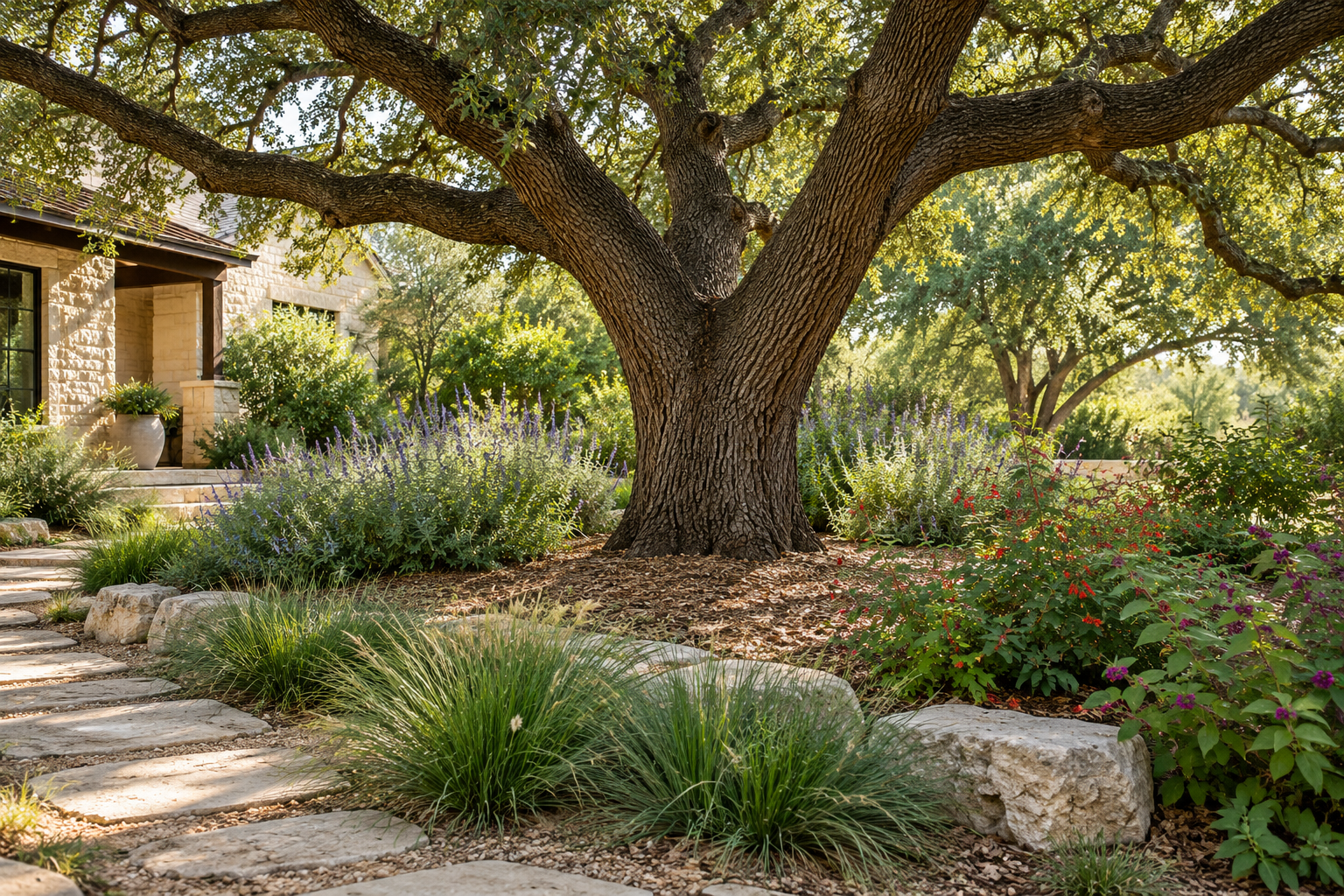
Live oak shade is usually both dense and dry. Rain may be intercepted by the canopy, and the tree’s wide root system competes efficiently for water. Close to the trunk, digging is difficult and can injure important roots. Farther toward the edge of the canopy, filtered light and rainfall increase, so more plants will grow.
Conditions also differ across Central Texas. West Austin often has shallow, rocky limestone soil; eastern areas may have deeper clay that absorbs water slowly. A plant that works in one neighborhood may need a different watering schedule only a few miles away.
Start by protecting the tree
- Do not add a raised bed over the roots. Changing the soil grade can reduce oxygen around established roots.
- Avoid trenching and rototilling. Hand-dig small individual holes, moving the hole when you meet a major root.
- Keep irrigation away from the trunk. Water new plants at their own root balls rather than keeping the oak’s crown constantly wet.
- Use small nursery containers. Four-inch pots and one-gallon plants require less excavation and usually establish more easily than large specimens.
- Leave the root flare visible. Mulch and soil should never be piled against the trunk.
In Austin, major disturbance inside the critical root zone of a protected or heritage-size tree may also be regulated. Large construction, grading, or hardscape projects near a live oak should be discussed with a qualified arborist before work begins.
Map the area in three planting zones
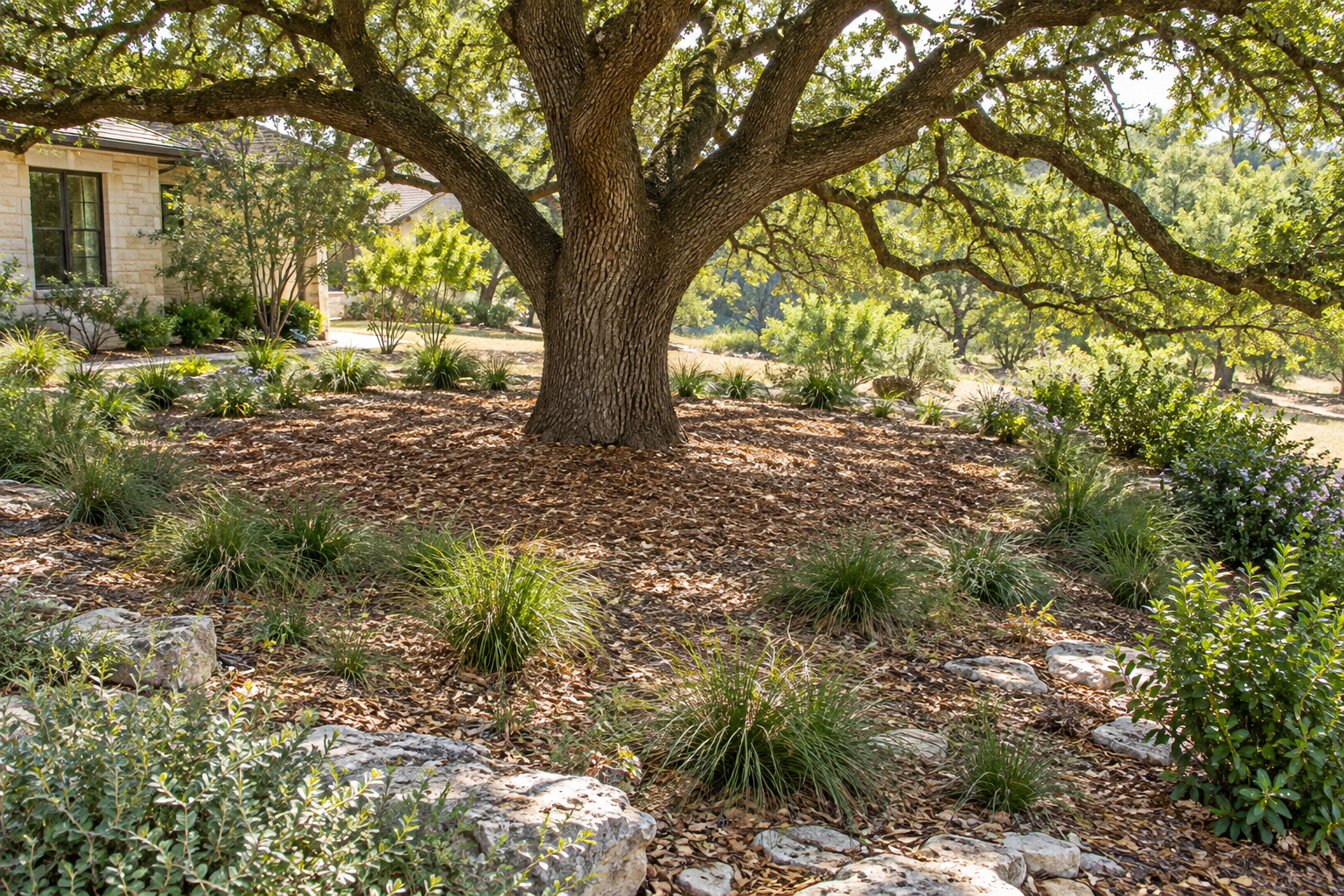
Zone 1: Near the trunk
The darkest, driest area is usually best left as leaf litter or coarse mulch. Trying to force a dense planting here often leads to repeated digging and watering, neither of which benefits the oak. A simple open ring also keeps mowers and string trimmers away from the bark.
Zone 2: Mid-canopy
This area receives filtered light but still has strong root competition. Use tough groundcovers, sedges, and scattered perennials in small pockets. Do not expect every plant to grow at the same rate.
Zone 3: Outer drip line
Near and just beyond the canopy edge, morning or late-day sun makes flowering shrubs and larger perennials more practical. Place the showiest plants here, where they receive more light and are easier to water without soaking the trunk.
Best plants for dry shade under live oaks
Texas sedge
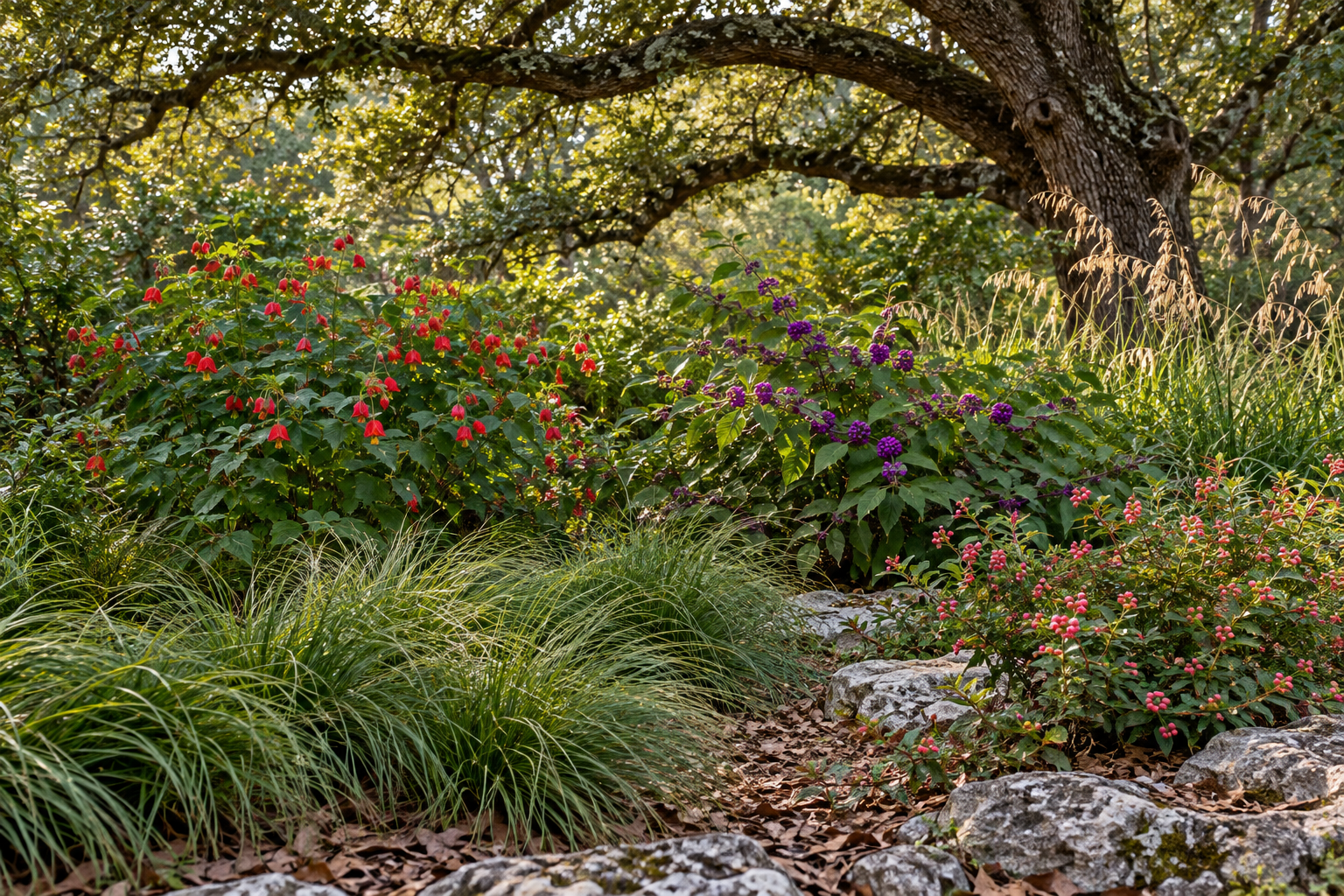
Carex texensis creates soft clumps of narrow foliage and can visually replace lawn where turf has failed. It works best in repeated groups rather than as isolated plants. It tolerates shade and dry periods once established, but new plugs need regular attention during their first summer.
Cedar sage
Salvia roemeriana is well suited to rocky, well-drained shade. Red spring flowers attract hummingbirds, and the low foliage fits between tree roots. Cedar sage may retreat during the hottest part of summer, so pair it with plants that provide later-season structure.
Horseherb
Calyptocarpus vialis is a low, spreading plant with tiny yellow flowers. It often appears naturally beneath Austin trees and can tolerate occasional mowing. Horseherb is a good choice for an informal green ground layer, but it is not a perfectly uniform evergreen lawn and may go dormant during drought.
Coralberry
Symphoricarpos orbiculatus is a native deciduous shrub that accepts shade, limestone soil, and competition. Its arching stems and small berries give a woodland character. Because it spreads by suckers, use it where a loose colony is welcome rather than beside a formal edge.
Turk’s cap
Malvaviscus arboreus var. drummondii handles heat and shade and flowers for a long season. It is most effective in the middle or outer zone, where filtered light encourages more blooms. Mature plants can form broad thickets, so provide several feet of space.
American beautyberry
Callicarpa americana gives the understory height and produces purple berry clusters in late summer and fall. It prefers the brighter outer portion of the canopy and looks better with occasional deep watering. The open, arching shape suits naturalistic beds better than tightly clipped foundation planting.
Inland sea oats
Chasmanthium latifolium is one of the few ornamental grasses that performs in shade. Its flat seed heads provide movement and winter interest. It can spread rapidly by seed and rhizomes, especially with regular irrigation, so keep it away from small beds where self-seeding would become a nuisance.
Dwarf yaupon holly
Dwarf forms of Ilex vomitoria provide evergreen structure and adapt to a wide range of Texas soils. They tolerate shade, although growth is looser and fruiting is reduced in low light. Select a genuinely compact cultivar rather than repeatedly shearing a full-size yaupon.
River fern for moister pockets
Thelypteris kunthii is appropriate only where the soil naturally retains more moisture or can be watered without keeping the oak trunk wet. It spreads into an attractive fern colony and brings a cooler woodland texture, but it is not a dry-zone plant during establishment.
Cast iron plant for deep shade
Aspidistra elatior is a nonnative but durable option for the deepest shade near a building or courtyard. Its evergreen leaves need little light, although winter cold can damage the foliage. Use it as one part of a mixed garden rather than the only understory plant.
Plants and approaches to avoid
- Sun-loving turfgrass: even St. Augustine generally needs several hours of useful light and often continues declining as the canopy becomes denser.
- Water-hungry annual beds: frequent shallow irrigation encourages weak roots and creates unnecessary competition.
- Aggressive English ivy: it can escape the bed and climb trunks, hiding defects and creating maintenance problems.
- Large shrubs planted close to the trunk: they require big holes and can crowd the tree as they mature.
- Deep layers of imported topsoil: adding soil over an established root system changes air and moisture movement.
How to install the understory
- Remove unwanted grass without deep cultivation. In open areas, sheet mulching can reduce disturbance, but keep cardboard and mulch away from the trunk.
- Mark existing surface roots and choose planting pockets between them.
- Arrange small containers before digging. Repeat a few species instead of buying one of everything.
- Dig only as large as each root ball requires. Never cut a large oak root simply to preserve the original layout.
- Water each new plant thoroughly and monitor it through at least the first hot season.
- Apply roughly 2–3 inches of coarse mulch over bare soil, leaving the trunk and plant crowns clear.
The City of Austin recommends broad mulch areas because mulch moderates soil temperature, conserves moisture, and reduces competition from turf. A thin layer of compost beneath the mulch can improve the soil surface, but deep soil amendment beneath an established oak is unnecessary and potentially harmful.
A practical low-water layout
Keep the inner area beneath the trunk mulched. In the mid-canopy zone, repeat Texas sedge and cedar sage in small drifts, allowing existing horseherb to fill some gaps. Near the brighter outer edge, use Turk’s cap and American beautyberry for height, with a controlled group of inland sea oats for texture.
This approach leaves much of the root zone undisturbed, concentrates irrigation where new plants actually need it, and looks intentional even before the understory fills in.
When mulch is the better answer
If the canopy is extremely dense, the soil is packed with large roots, or the oak is already stressed, a planted bed may not be worth the risk. A wide mulch zone with a few containers at the perimeter can look finished while giving the tree priority. The goal is not to prove that something can grow everywhere; it is to create a durable landscape without sacrificing the live oak that provides the shade.
Local guidance
For species selection, consult the Lady Bird Johnson Wildflower Center’s native plant resources and the City of Austin Grow Green Plant Guide. The City’s guidance on mulching Austin trees recommends a broad layer generally 2–3 inches deep and keeping mulch away from trunks. For construction or significant grading near a large tree, review Austin’s residential tree-protection requirements or consult a certified arborist.