Native shrubs are the backbone of a low-maintenance shade garden in Central Texas. They add height, structure, flowers, berries, and wildlife value without demanding the constant irrigation that many exotic ornamentals need. The key is to match each shrub to the actual light beneath your trees: bright dappled shade is very different from the dry darkness beside a live oak trunk.
The shrubs below are adapted to regional heat and soil conditions and can handle at least partial shade. Most become drought tolerant after establishment, but all need thoughtful watering during their first year.
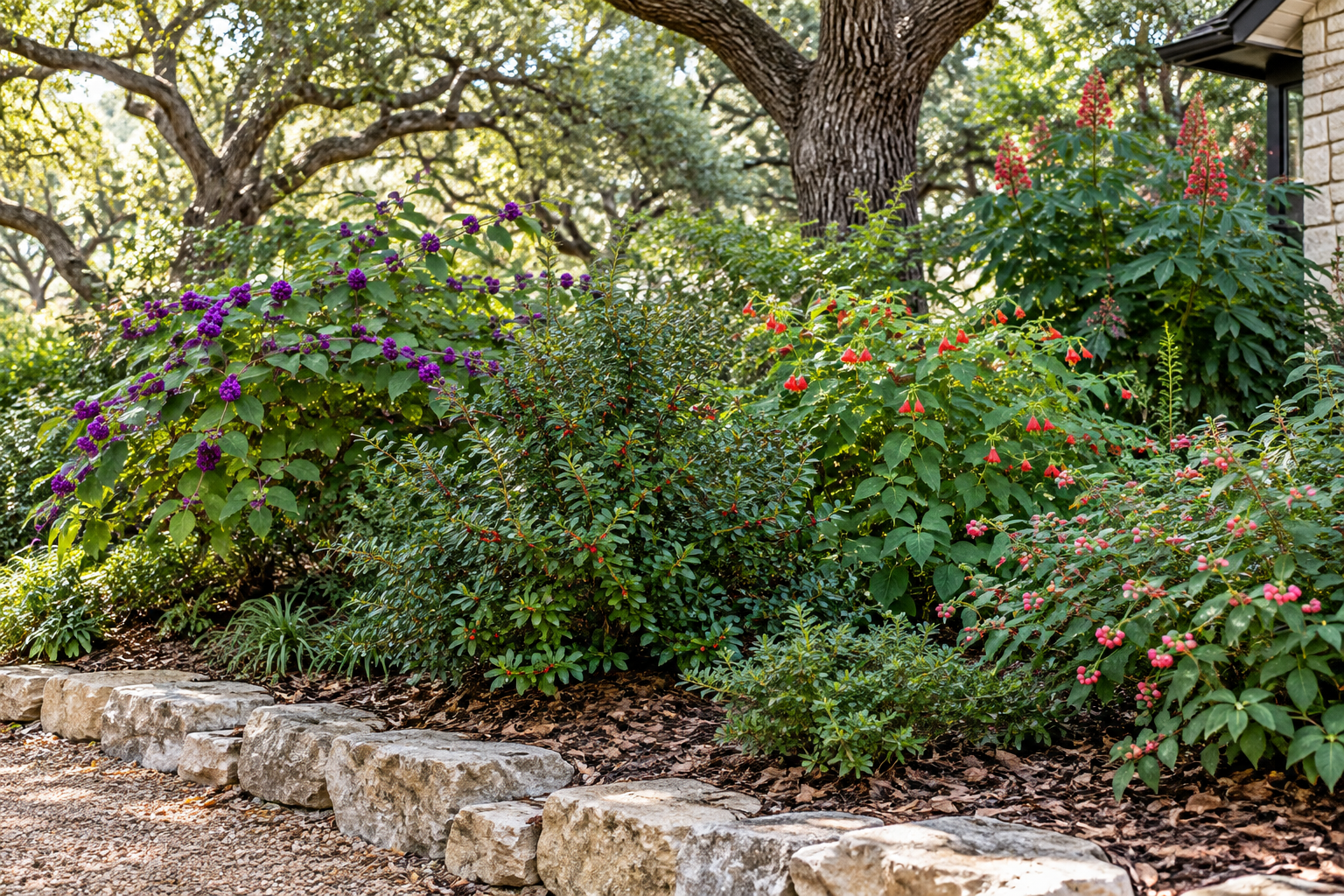
Quick comparison: native shrubs for Central Texas shade
| Shrub | Light | Size | Main feature | Evergreen? |
|---|---|---|---|---|
| American beautyberry | Part shade | 4–6 ft. | Purple berries | No |
| Yaupon holly | Part shade to shade | 3–20 ft., by variety | Evergreen structure, red berries | Yes |
| Turk’s cap | Part shade to shade | 3–5 ft. | Red flowers for hummingbirds | Usually deciduous |
| Coralberry | Part shade to shade | 3–5 ft. | Pink-red winter fruit | No |
| Elbowbush | Part shade | 6–10 ft. | Very early spring flowers | No |
| Rusty blackhaw viburnum | Part shade | 10–20 ft. | Flowers, fruit, fall color | No |
| Red buckeye | Part shade | 8–15 ft. | Red flower spikes | No |
| Agarita | Bright shade to sun | 3–6 ft. | Evergreen foliage, yellow flowers | Yes |
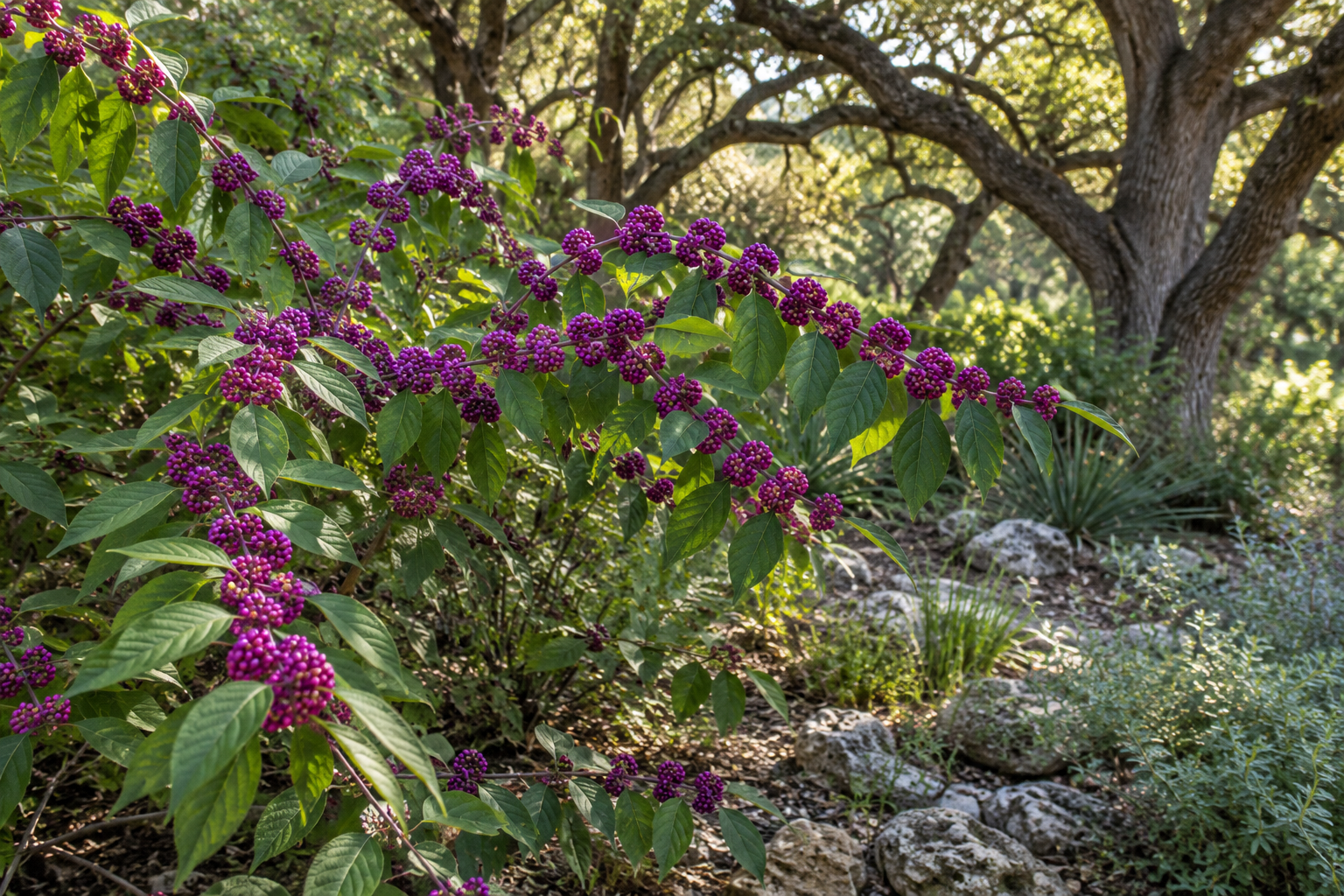
1. American beautyberry
American beautyberry (Callicarpa americana) is one of the easiest native shrubs to recognize. Clusters of brilliant purple berries circle the stems in late summer and fall, providing food for birds and strong color in a shaded border.
Beautyberry grows best in dappled light or morning sun with afternoon shade. It accepts a range of soils and tolerates dry periods once established, although it looks fuller with occasional deep watering. The shrub can become loose and arching, so give it enough room rather than squeezing it against a walkway. If needed, prune in late winter because flowers and fruit form on new growth.
2. Yaupon holly
Yaupon holly (Ilex vomitoria) is an exceptionally adaptable Texas native. The species can become a large shrub or small tree, while dwarf cultivars stay compact enough for foundation beds. Its small evergreen leaves provide year-round structure, and female plants produce red fruit when a compatible male is nearby.
Yaupon handles shade, heat, drought, and pruning, making it useful where a dependable evergreen screen is needed. Growth is denser with more light and looser in deep shade. Choose the form carefully: a full-size yaupon planted in a small space creates years of unnecessary pruning.
3. Turk’s cap
Turk’s cap (Malvaviscus arboreus var. drummondii) behaves like a soft, spreading shrub. Its curled red flowers appear through the warm season and attract hummingbirds. It is especially valuable in places where flowering shrubs receive too little sun to bloom well.
In Central Texas, frost often cuts the stems to the ground, but the plant normally returns from its roots in spring. Turk’s cap can spread into a broad colony, so use it where a relaxed mass is welcome. A late-winter cutback keeps the planting tidy.
4. Coralberry
Coralberry (Symphoricarpos orbiculatus) is a low, thicket-forming native shrub suited to naturalistic shade gardens. Small flowers are followed by clusters of pink to reddish fruit that can remain visible after the leaves drop.
It works well on slopes, at woodland edges, or behind a more formal foreground. Because it spreads by underground stems, coralberry is better for filling an area than for maintaining a single specimen. It tolerates dry shade after establishment and provides cover for wildlife.
5. Elbowbush
Elbowbush (Forestiera pubescens) is an underused native with angular branches and tiny flowers that open very early, sometimes before the leaves appear. Those blooms offer an early food source for pollinators. Female plants may produce dark fruit when a male plant grows nearby.
This shrub has an informal shape and fits best in a wildlife garden, screen, or woodland transition. It tolerates limestone soils and periodic drought. Plant it where its natural branching can be appreciated rather than repeatedly sheared.
6. Rusty blackhaw viburnum
Rusty blackhaw (Viburnum rufidulum) is a large shrub or small understory tree. White spring flower clusters are followed by dark blue fruit, and the foliage can develop rich red and burgundy tones in fall. It is a strong choice when the garden needs height below a high tree canopy.
Give rusty blackhaw good drainage and enough space to mature. It prefers bright shade or filtered light; flowering and fruiting may be reduced in very dark locations. Once established, it is durable and generally needs little pruning.
7. Red buckeye
Red buckeye (Aesculus pavia) produces showy red flower spikes that attract hummingbirds in spring. It naturally grows as a large shrub or small tree and is well suited to a shaded courtyard or woodland garden.
The plant may drop its leaves early during hot, dry summers. This is a normal drought-avoidance strategy, not necessarily a sign that the plant has died. Position it behind later-season plants so the temporary gap is less noticeable. The seeds and other plant parts should not be eaten.
8. Agarita
Agarita (Mahonia trifoliolata) is a tough evergreen shrub with holly-like leaves, yellow spring flowers, and red fruit. It is highly drought tolerant and well adapted to rocky limestone soils.
Agarita performs best in sun or bright, open shade rather than beneath the densest canopy. Its pointed leaflets make it a useful barrier plant but a poor choice beside narrow paths, play areas, or frequently maintained beds. Place it at the outer edge of the shade zone where it receives several hours of light.
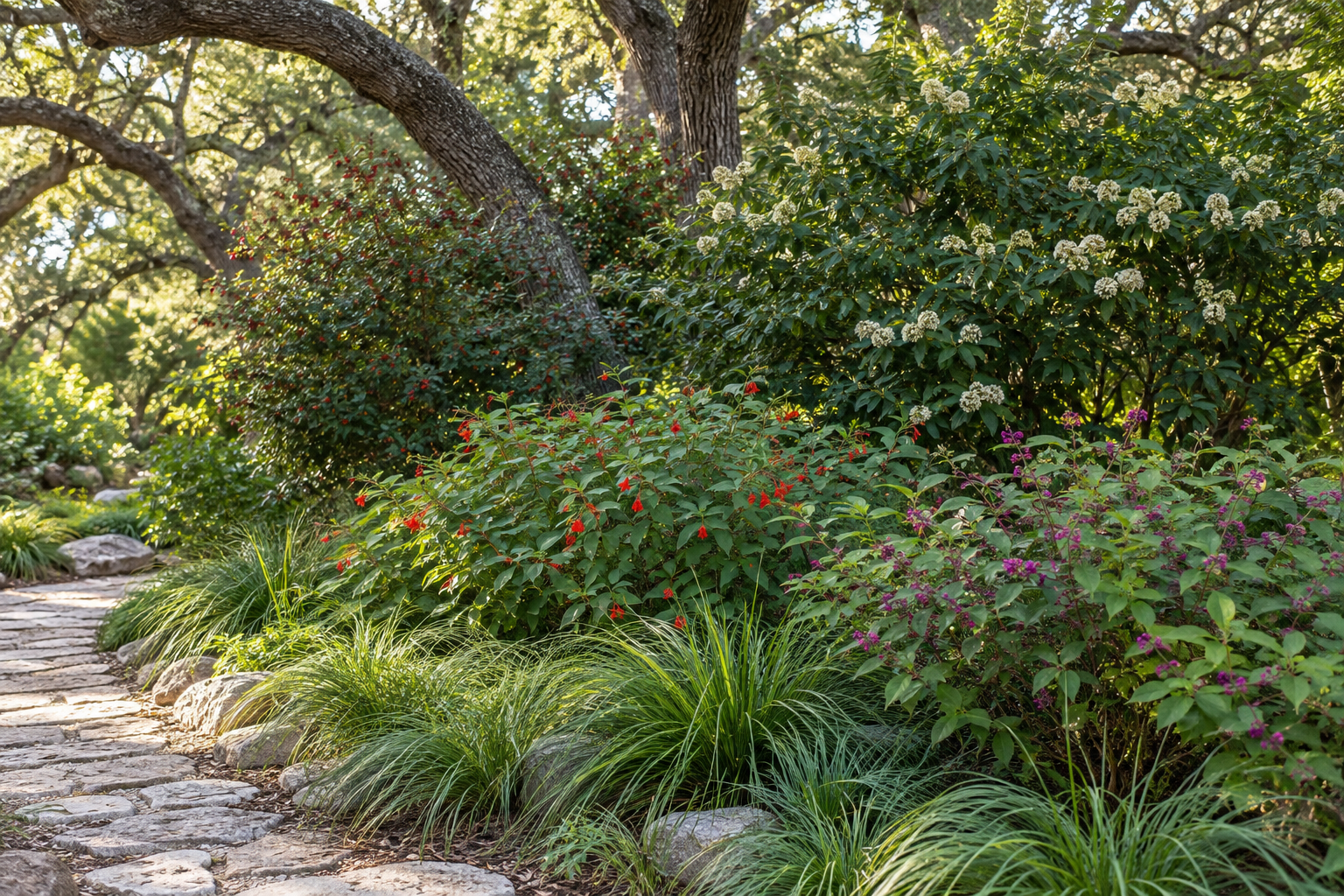
How to design with native shrubs in shade
Build layers instead of a hedge
A natural woodland edge has several heights. Start with one or two structural shrubs such as yaupon or rusty blackhaw. Add medium masses of beautyberry, Turk’s cap, or coralberry, then finish with low sedges and woodland perennials. Repetition creates unity without making the planting look rigid.
Respect mature size
Small nursery plants are deceptive. Space shrubs for their expected mature width, not their size in the container. Proper spacing improves air movement, reduces pruning, and leaves less competition for tree roots.
Preserve the tree root zone
When planting beneath mature trees, use the smallest practical containers and avoid cutting large roots. Do not rototill, raise the grade, or build deep beds over the root system. A mulch-only area close to the trunk is often healthier than trying to fill every square foot with shrubs.
Group plants by water need
Even native shrubs need supplemental water while establishing. Place plants with similar moisture needs on the same irrigation zone. Water slowly and deeply, then allow the upper soil to begin drying before watering again. Frequent shallow sprinkling encourages weak surface roots.
A sample native shade border
For a 20-foot woodland edge, anchor one end with a multi-trunk yaupon and the other with a rusty blackhaw. Repeat three American beautyberries through the middle, leaving room for their arching form. Fill the foreground with Turk’s cap and Texas sedge, and use coralberry on the side where a spreading colony will not interfere with a path. This combination provides evergreen structure, spring flowers, summer hummingbird activity, fall berries, and winter texture.
Common mistakes to avoid
- Choosing by appearance alone. Confirm light, drainage, mature size, and spreading habit before buying.
- Planting too close to the trunk. The darkest, driest inner zone is often better left mulched.
- Expecting instant drought tolerance. Plan regular establishment watering through the first summer.
- Shearing every shrub. Most native species look and perform better with selective pruning.
- Ignoring seasonal dormancy. Leaf drop in winter—or summer dormancy in red buckeye—can be part of a healthy cycle.
Final thoughts
The best native shrubs for Central Texas shade do more than survive low light. They create habitat, reduce irrigation demand, and give a garden structure through the seasons. Match each plant to the light available, allow room for mature growth, and be patient during establishment.
To complete the lower layer, explore our guides to shade plants for Central Texas and drought-tolerant ground covers. For locally vetted plant information, use the City of Austin Grow Green Plant Guide and the Lady Bird Johnson Wildflower Center’s plant database.